Wednesday, October 18, 2017

SAT., OCT. 14, 2017 - DAY #5 OF SAFARI - SAMBURU TO SWEETWATERS TENTED CAMP, OL PEJETA - We began this day with an early breakfast so that we could board the van and make what amounts to a "game drive" as we departed this beautiful area.  Our first sighting was the baboons.


And, I seem to be fascinated by these termite hills. 


Then we crossed what appeared to be a rather large stream...


...using a bridge!

Shortly after we came across a herd of Biesa Oryx


and a dead zebra

Nearby was a small herd of zebras.  Note these are known as Grevy's zebras i.e. mainly distinguished from others because of having white bellies & a different stripe pattern.


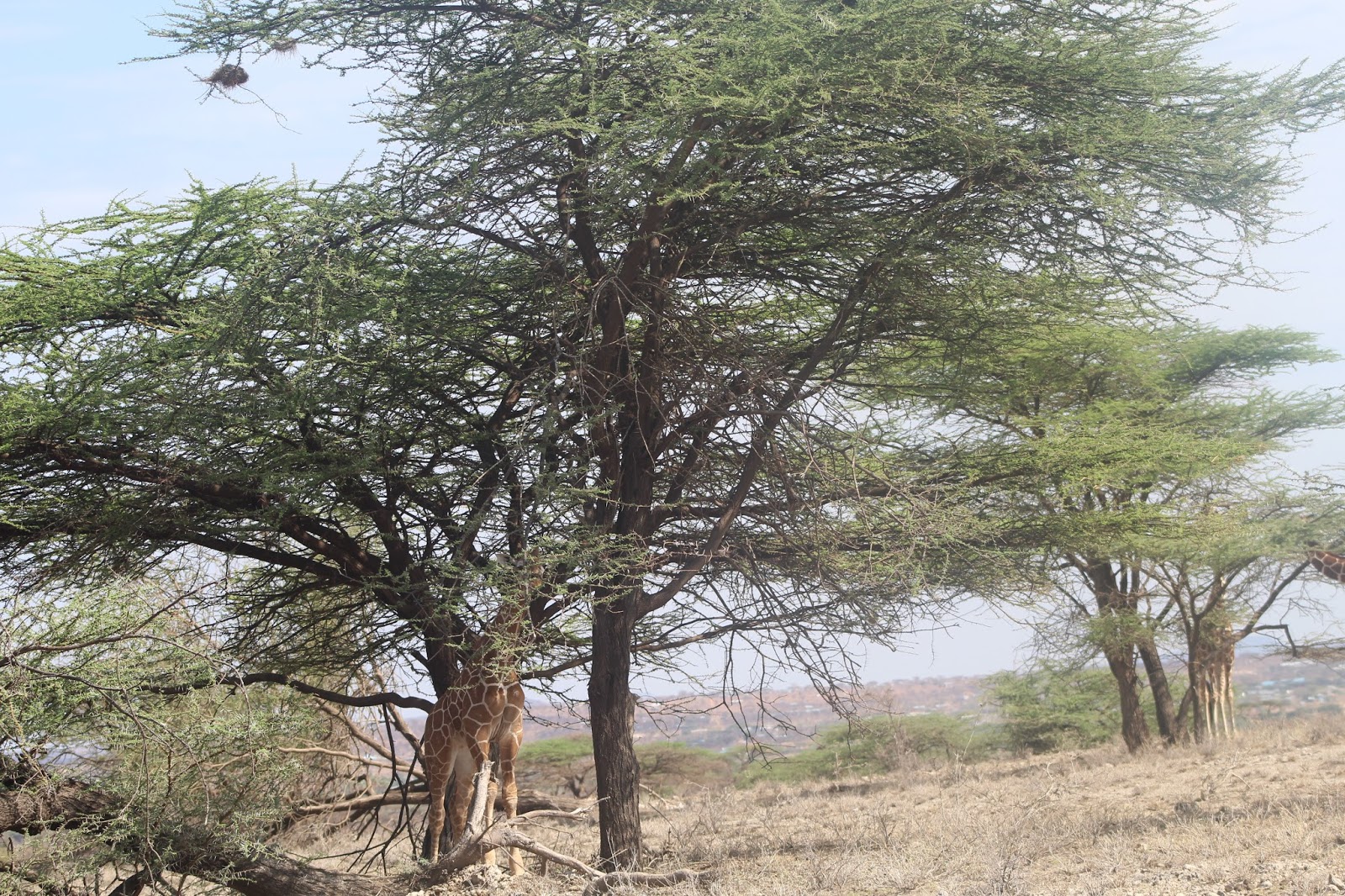
And a giraffe in these trees...


 And, the final animal of the named Samburu 5, the Cape Buffalo


It seemed our morning game drive had ended with the sighting of the cape buffalo.  

We soon came to what appeared to be a nice, wide paved road.  Traveling down that road was  a herd of camels.


We Continued across the wilderness & jungle until about 1:30 p.m. when we arrived at the Sweetwaters Tented Camp of Ol Pejeta Conservancy.

Located on the plains of Mount Kenya, Sweetwaters Tented Camp is a sheltered oasis, clustered around a water hole and set in the pristine calm of the private Ol Pejeta Conservancy.  It offers a charming blend of under-canvas ambiance and safari luxury.

The camp features 39 luxury tents, each with its own private veranda overlooking the waterhole.  Each tent is fitted with its own en-suite bathroom (continuous hot & cold running water), king-sized double bed or twin beds, 24-hour (generator) electricity, mineral water and toiletries, bathrobes and slippers, safe,  hairdryer, and mosquito nets.  The tents have a canvas exterior with solid flooring and thatched roofing.  14 of the tents are on raised platforms with private balconies.  The others have private verandas, all with safari chairs and tables.

The Rhino Restaurant is housed in the former manager's house of this once colonial farm and offers both regional and international cuisine.  Breakfast and lunch are presented in buffet style.  Vegetarian options are always available.  The majority of the meat, fruits, vegetables, and dairy products come from the communities that surround the reserve.  Also within this house is the Kashoggi Bar and lounge which boasts a large wood fireplace.  The Waterhole Bar, built in the style of a game-viewing hide, overlooks the waterhole and offers unrivaled wild-life watching.

Below is a picture of our room at the tented camp.  This is looking at the back tented wall that, when the beds were turned down & the hot water bottles put in place, was dropped separating the bathroom area from the sleeping area.

This is a somewhat blurry picture of the resident stark (I think) that was on the grounds.  (Picture was taken looking through the window and did not come out very acceptable).

This is the entrance of the large old former manager's house that is now the dining hall/bar, etc.

Upon arrival, we had lunch and after a short break, then departed for a visit to the Jane Goodall Chimpanzee sanctuary (closed about 4 p.m.). 


The Sweetwaters Sanctuary is located in a game reserve near Nanyuki, Kenya.  A number of chimpanzee orphans that been rescued from other countries are kept at Sweetwaters, as chimpanzees are not native to Kenya.  Their plight is largely the result of habitat destruction, the bushmeat trade, and the killing of mothers so that their infants can be sold as pets, or for medical research and entertainment industries.  Also, some die from infections from wounds caused by snares set for other forest animals.  Sweetwaters is home to 22 chimps.

We climbed a viewing platform but could see only the playground and sleeping quarters--no chimps.  Finally, our guide was able to coax these two chimps out away from the others who seemed to be in hiding.
(Note the fencing to prevent both access out of and into the sanctuary area).

This chimp is known as "Manno"
When the process to move Manno to the Goodall sanctuary began in 2013 it was estimated that Manno was about four years old.  At that time the info shows: "Manno has had a grueling start to life; wrenched from his mother as a baby; he was trafficked by profit-hungry organized criminals across continents, and has survived at least two war zones.
Since 2013, the young chimpanzee had been resident at a private zoo in Dojuk, in the Kurdish region of northern Iraq, just a few miles from war-river Mosul, surviving on a diet of fruit, caffeinated drinks, and even the occasional cigarette."
Eventually, through the efforts of many different people, Manno arrived at the Jane Goodall Sweetwaters Sanctuary where he lives today.


As our guide was escorting us toward the departure gate, it seemed that a larger group of people had arrived and with it, a larger group of chimps had assembled.  We wanted to start over our tour, but that was not allowed.

We continued on for our early evening game drive, spotting these beautiful zebras with striped bellies, known as "common zebras".


AND THEN WE SPOTTED THE RHINOCEROS 


One large male, (about 2 tons) the apparent leader of his herd, was standing about 20 feet from our van.  He seemed to want to challenge the van, and backed up and positioned himself to charge.  At that point Amos began to back the van away from his planned route of attack, stopping the van some distance away.  Then the Rhino male proceeded to follow and begin the process again.   At that point, Amos backed away again and we departed before he made contact.


As we hurriedly departed from watching the rhinos, we then drove to the viewing area of elephants.
and a younger one


Followed by cape buffalo


And finally, this picture with 3 different animals
giraffe, zebra, & warthog


And as an ending (about the "blue hour"), the silhouette of giraffe & zebras against the mountains.

Tuesday, October 17, 2017

SUN., OCT. 15, 2017 - DAY #6 OF SAFARI - SWEETWATERS CAMP TO LAKE NAKURU & LAKE NAIVASHA, NAIVASHA SOPA LODGE - As usual we made an early start for our day of travel between Sweetwater Camp and Lake Nakuru & Lake Naivasha.  My first recorded stop of the day was at the monument marking the equator in the city of Nyahururu, altitude 7,743 ft.


                   The Equator, Kenya, Africa
     Sylvia & Jim,10/15/2017


Our Group of 7:
L to R:  Jan, Jo, Shelly, Hedy, Amos, Sylvia, & Jim


After a break at this monument, we continued to climb in the mountains.

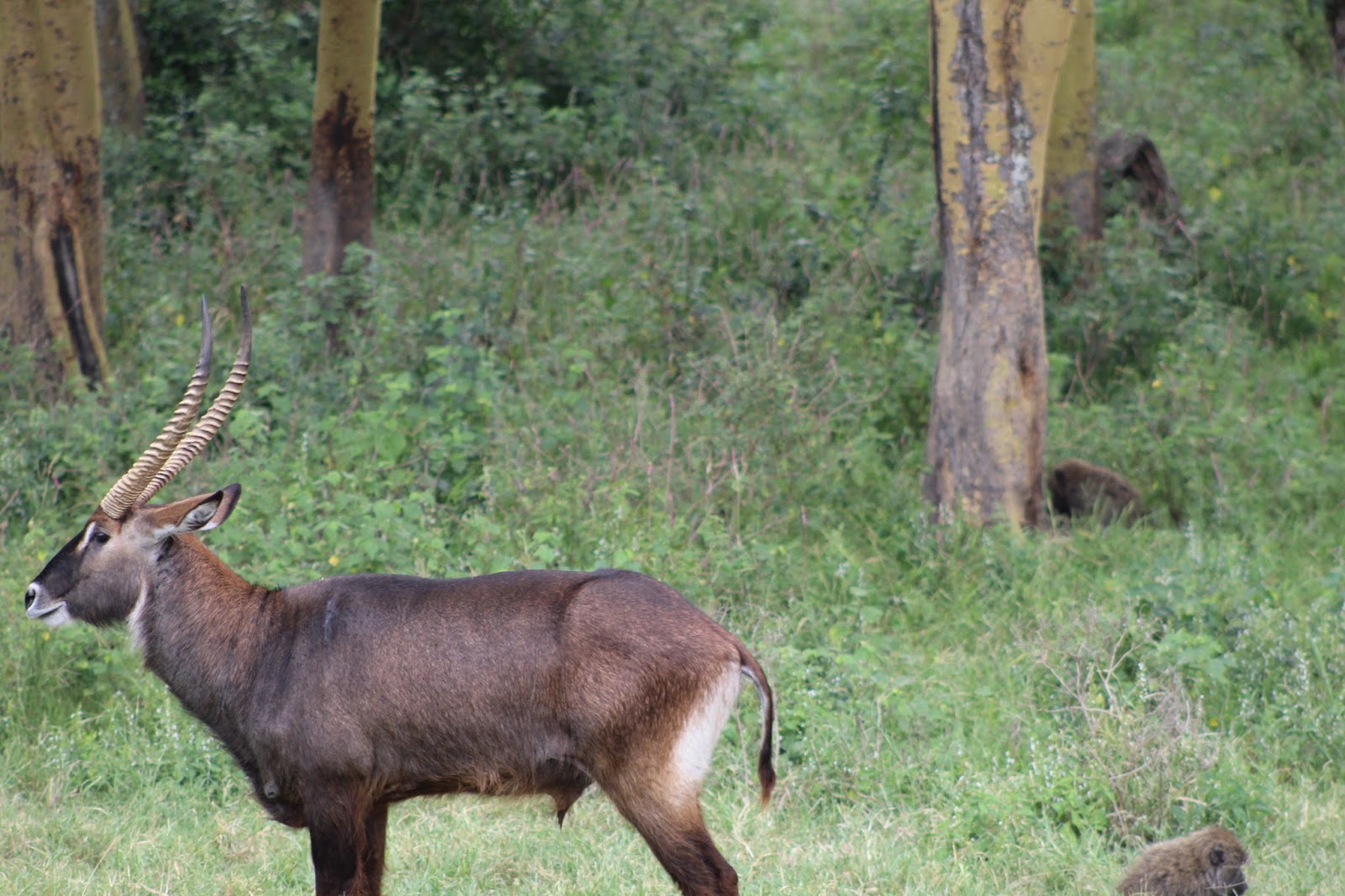
 Here we saw antelope
 baboons


 grey crowned crane

 On this common zebra, note the patterns of the stripes


 pay close attention to the stripe pattern on the head of the middle animal

In the mountains, we stopped for lunch in a picnic area.  Amos had arranged for the kitchen at the Sweetwaters Camp to pack box lunches for us.  There were 7 boxes, each with 13 items in them including multiple sandwiches of assorted flavors, fried chicken, an orange, an apple, etc.

Across the road from the picnic table was a set of bathrooms.  The women indicated they would use them while the men suggested they would "locate a tree" or "check a tire" as Amos called it.  One woman was in one toilet; Jo went into the second & came out immediately yelling there was a bat inside.  So, I then went to investigate stepping inside but not locating a bat, I came back out banging on the door as if to scare anything inside away.  Jo went back inside and was immediately met by a wasp or bee that stung her on the eyelid. The bite was very painful & her eye swelled shut within a short period of time.  There were 2 different types of medicine for bites offered.  She chose the Afterbite which did seem to help some with the pain but not the swelling.  

Our next stop was Lake Nakuru.  Prior to arriving there, Amos told us (and Jo joined in to say she remembered 16 years ago when she visited Kenya) that the lake was completely solid with the pink flamingos on it.  Amos said that the flamingos were drawn to the lake because of the algae that grew in the lake.  With changes of the weather patterns, the lake began to receive an unusually large amount of fresh water in it which resulted in fewer algae and thus fewer flamingos.


The final two animals we spotted were this giraffe... 

 ...and this cape buffalo.

Shortly before 5 p.m., we arrived at Naivasha Sopa Lodge, Lake Naivasha.

Lake Naivasha Sopa Lodge is situated by the shores of Lake Naivasha, a sweet water lake approximately 68+ sq. miles in size and home to many varieties of flora and fauna. 

The resort is on 120 acres of prime land.  The construction of the lodge features 3 fireplaces each with a huge inverted copper funnel-shaped chimneys, a high roof with glass panels which open out to a small terrace with beautifully manicured grass and colorful flowers, wrought iron chandeliers, and walls decorated with intricately carved wooden panels.

Naivasha is a Masai name given to the area where the resort is located.  It denotes the characteristics of the lake including the size and its tendency to be rough when windy. 

The history of the area has always been important as it formed the main route of the slave trade from Uganda and the highlands of Kenya.  This includes the Scottish explorer Joseph Thompson's epic journey through Masai land, where he writes in his journals of his time in Naivasha in 1884.

The Lake Naivasha Sopa Lodge has 21 cottages built in a crescent shape comprising 84 rooms total.  The pathways from reception to the rooms are lined with various kinds of plants and colorful flowers.  Little rock gardens are also found along these paths creating a beautiful contrast with the greenery of the well-manicured lawns.  Several species including (black & white) Colobus monkeys are often spotted playfully rolling on the lawns.

You will also hear many different species of birds chirping in the acacia trees scattered about the property.  All 84 rooms are tastefully furnished with mahogany colored furniture.  The walls have paintings and locally woven sisal pieces placed in embedded concrete frames which form part of the wall.  The rooms are spacious, airy and light. They are also equipped with sunken bathtubs and bidets, minibars, TV's, telephones and safes.

The main restaurant is located at one side of the lobby.  In the center, hanging from a high wood paneled ceiling is a huge intricately done wrought iron chandelier.  The colors are a rich dark green, which is carried throughout in the upholstery & carpet. There is a bar which sits on one side and a buffet station on the other.  A tree grows right by the buffet area and adds to the character of the dining room.  This room opens out to an area where guests can sit and enjoy the garden in front of them, and have their pre or after dinner drinks and coffee.  There is also a snack bar at the pool which serves a light a la carte menu, and a pizzeria next to it.  This is a very pleasant and relaxing area with the swimming pool next to it and the beautiful gardens right in front.  The main bar is in the lounge area, with the second one in the dining room.

The drive into Sopa Lodge 


Some of the cottages.


 Our 2nd-floor room balcony in the above-shown cottage.


The night in a "hotel" was somewhat of a change from tented rooms, even though we still had the rain shower (no tub) and other situations to deal with.  One of those situations was because this hotel was situated on the shores of a lake, it was a natural watering hole for many animals, and after dark hippopotamuses.  Because these animals roamed the entire area of the cottages after dark we were cautioned to call the reception desk for an escort before venturing out of our rooms and never to return from the reception building to the cottages without an escort.  We obeyed this warning, and on the return to our room after dinner, the escort took us to see a hippopotamus. However, without a camera (and in a mostly dark area) we were unable to get a photograph.  So we departed early the following morning without any pictures of the notorious (deadly to humans) inhabitants of this lodge area.